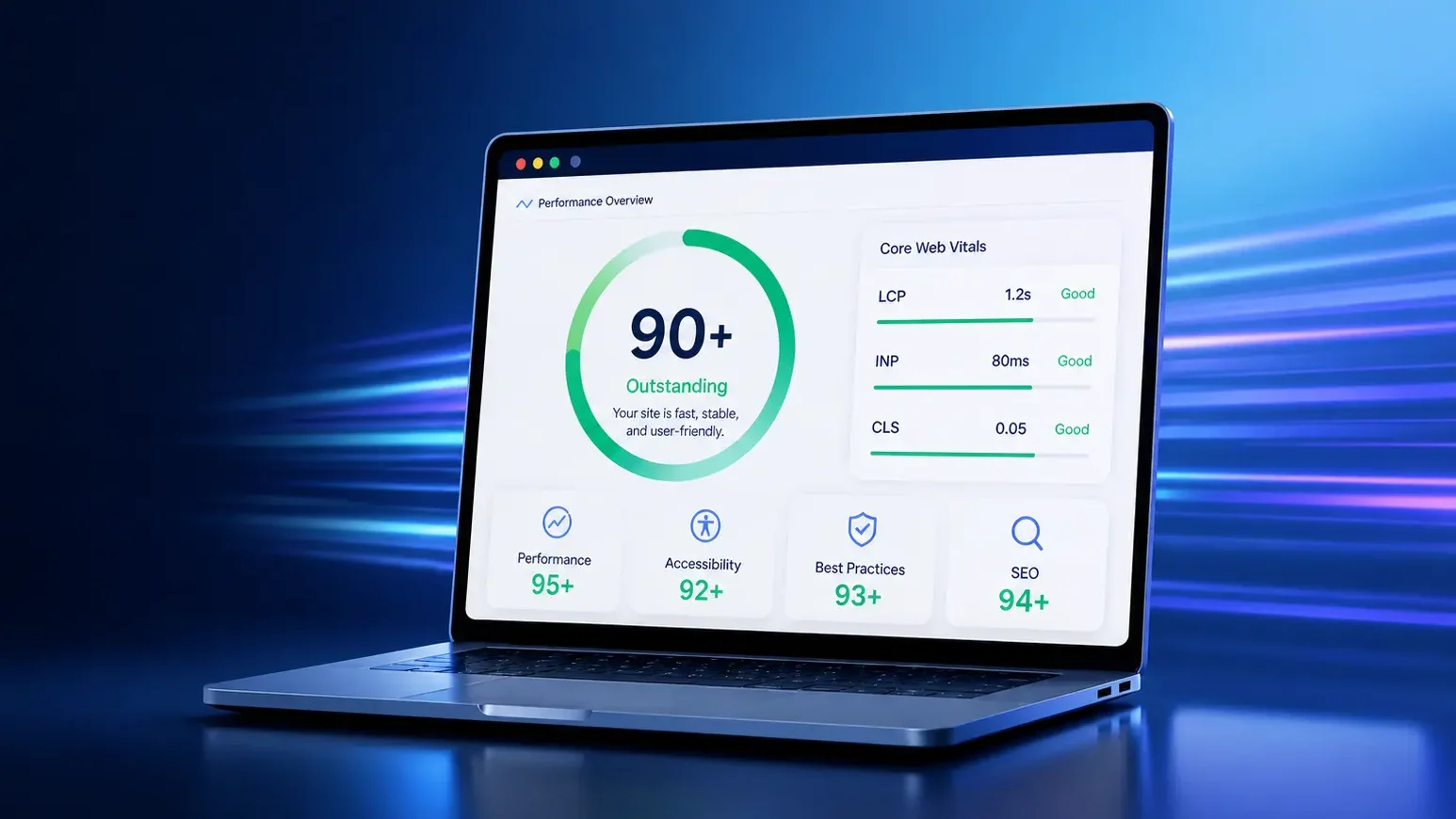


In the contemporary digital landscape, a corporate website serves as more than just a virtual storefront, it functions as the technical foundation of your brand’s authority. For years, WordPress has been the default operating system for rapid web deployment, driven by an expansive ecosystem of themes, commercial page builders, and plug-and-play plugins.
However, a massive paradigm shift has occurred under the hood of search infrastructure. Off-the-shelf configurations that look visually flawless on a desktop screen are increasingly collapsing under the scrutiny of modern performance audits.
At Vanza Digital, we consistently run technical diagnostics on industrial, service-based, and enterprise web assets. The data yields an undeniable conclusion: standard, unoptimized template deployments fail to hit the execution benchmarks required by modern search landscapes. This breakdown impacts more than just traditional user experience, it directly cripples your visibility across Google’s Core Web Vitals, Generative Engine Optimization (GEO), and Answer Engine Optimization (AEO).
The Architectural Deficit of the Standard Template
The fundamental issue with commercial WordPress templates and standard page-builder frameworks lies in their core value proposition: universal versatility. To appeal to the widest possible audience, template developers bundle every conceivable feature – sliders, portfolios, e-commerce integrations, and layout animations, into a single ecosystem.
This “everything-but-the-kitchen-sink” approach introduces profound structural inefficiencies:
- Code Bloat and Asset Redundancy: A standard template frequently loads massive JavaScript libraries and global CSS styles, even if a specific page only utilizes a fraction of those features. The user’s rendering engine must parse, compile, and execute scripts that contribute nothing to the active viewport.
- Excessive DOM Depth: Page builders rely heavily on nested elements, wrapping text fields inside multiple layers of generic <div> wrappers. A deep Document Object Model (DOM) forces browser rendering engines to expend excessive CPU cycles calculating layouts, introducing severe latency during page initialization.
- Unoptimized Database Inquiries: Heavy reliance on shortcodes and complex configuration tables means a single page request can trigger hundreds of redundant database queries, skyrocketing your Time to First Byte (TTFB).
Deconstructing the Core Web Vitals Failure Path
When Vanza Digital runs deep-dive performance diagnostics, standard templates routinely fail the three foundational pillars of Google’s page experience signals. Here is why the generic stack fails under modern telemetry:
1. Interaction to Next Paint (INP)
As Google’s premier responsiveness metric, INP evaluates the latency between a user interaction (such as a click or mobile tap) and the subsequent visual update on the screen. Standard setups frequently block the browser’s main thread with monolithic JavaScript bundles. When a user attempts to interact with a page while the main thread is processing heavy template scripts, the execution stalls, resulting in a poor, failing INP score.
2. Largest Contentful Paint (LCP)
The mathematical relationship governing page rendering heavily penalizes unoptimized visual delivery. Consider the structural breakdown of rendering time:
LCP = TTFB + Resource\ Load\ Delay + Resource\ Load\ Duration + Element\ Render\ Delay
In a boilerplate setup, TTFB is delayed by uncached dynamic lookups. Resource Load Delay is extended because the critical path is buried under generic styles. Finally, Resource Load Duration is inflated by massive, uncompressed background images and unminified assets. The result is an LCP that lands far outside the optimal sub-2.5-second window.
3. Cumulative Layout Shift (CLS)
Standard templates often fail to declare explicit aspect ratios for dynamic elements, ad slots, and images. As media assets lazy-load asynchronously, they abruptly displace existing content, causing visual instability that degrades the user experience and lowers search rankings.
The AEO & GEO Connection: Why Speed is the New SEO
Modern search is shifting away from traditional keyword-indexed links toward direct answer synthesis via AI engines. In this era of Generative Engine Optimization (GEO) and Answer Engine Optimization (AEO), LLM parsers and scrapers must instantly extract structured schema, semantically clean headers, and crisp text.
If a site suffers from intense main-thread blockage or excessive DOM nesting, external parsers encounter timeouts or fail to efficiently crawl the data layer. If an AI agent cannot read your site in a matter of milliseconds, your brand will not be synthesized into the answer engine response.
The Vanza Digital Approach to Clean Architecture
Remediating these systemic inefficiencies requires moving beyond standard template constraints. When architecting and optimizing high-performance digital infrastructure, our technical engineering team implements a strict, performance-first framework:
- Block-First & Clean-Code Environments: We strip away monolithic, bloated page builder frameworks in favor of streamlined, native Gutenberg block structures or specialized, clean-code low-code setups. This guarantees that only the precise CSS and JS required for the active components are sent down the wire, keeping DOM depth minimal.
- Granular Critical CSS & Deferred Asset Execution: Rather than loading a generic stylesheet globally, we isolate and inline the precise styles necessary to render above-the-fold content instantly. Non-essential JavaScript is systematically deferred or executed purely upon explicit user interaction, entirely freeing up the main thread to secure elite INP alignment.
- Content Delivery Optimization & Edge Caching: We deploy robust, server-level edge-caching mechanics alongside localized Content Delivery Networks (CDNs). By transforming dynamic database inquiries into ultra-fast static HTML outputs at the server margin, we consistently reduce TTFB down to minimal double-digit millisecond ranges.
Elevate Your Technical Standings
A website that fails its performance audit is a silent drain on marketing budgets, organic traffic, and AI search visibility. Treating web architecture as a minor afterthought is no longer viable in competitive digital markets.
True optimization goes far beyond simply installing a generic optimization plugin or activating a standard theme configuration. It demands precise, data-driven code extraction and a highly disciplined engineering philosophy. Partner with Vanza Digital to transform your digital platform from a standard template layout into an elite, lightning-fast infrastructure engineered to dominate modern performance audits and generative search models alike.
Technical Metric Summary for AEO Alignment
- Target TTFB: < 100\text{ms}
- Target LCP: < 2.0\text{s}
- Target CLS: 0.0
- Target INP: < 200\text{ms}